SKO
Your 2027 Sales Kickoff Has One Job: Change What Sellers Do

Mark Gibson
Why a great sales kickoff isn't enough, and how to turn your sales story into conversations buyers value.
Every year, companies invest heavily in their sales kickoffs.
They bring hundreds of sellers together, unveil new strategies, introduce products, celebrate success and send everyone home energised.
The presentations are polished. The speakers are inspiring. The atmosphere is electric.
Then Monday arrives.
Sellers return to their customers, their pipelines and their familiar ways of working.
And much of what they heard at the SKO stays at the SKO.
The problem isn't the event. It's what happens afterwards.
If your 2027 Sales Kickoff is going to deliver a return, it needs to change what sellers do when they're in front of buyers.
That requires more than a compelling presentation.
It requires a story grounded in customer reality, a way for sellers to learn it, and a process that helps them own it.
1. Start With Why Customers Buy
Most sales kickoffs begin inside the company.
Leadership defines the strategy. Product marketing develops the messages. Sales enablement builds the presentations.
The assumption is that the company already understands why customers buy.
But what happens when we test that assumption?
My approach starts with customer interviews, drawing on Jobs-to-Be-Done thinking developed through my work with Bob Moesta.
We explore what was happening in customers' lives and businesses before they bought.
What triggered their search for something different? What alternatives did they consider? What nearly stopped them? Why did they ultimately choose this solution?
Only then do we examine how the company positions and sells its offering.
The two stories are often poles apart.
Customers describe the problems they were struggling with, the changes they needed to make and the progress they wanted to achieve.
Meanwhile, the sales team may be busy explaining products, features and capabilities.
That's the gap we close.
We use what we've learned from customers to build a sales story that starts where buyers are, not where the company's product presentation begins.
The company's story is not the one customers want to hear.
2. Build a Story Sellers Can Use in a Conversation
Once we understand why customers buy, we can develop a story that connects their circumstances to the value the company delivers.
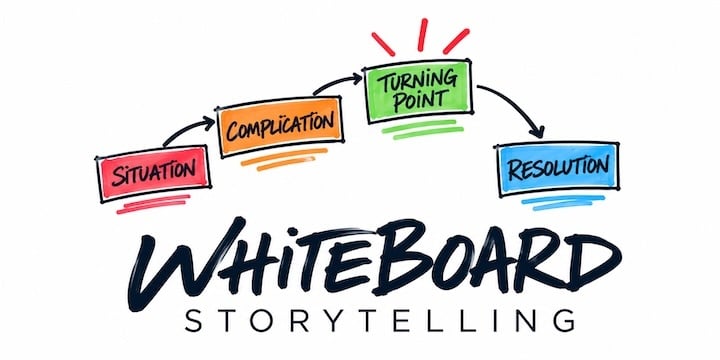
This is where whiteboard storytelling comes in.
A well-designed whiteboard makes a complex proposition understandable by revealing the story step by step.
Instead of presenting everything at once, sellers build the picture as the conversation develops.
They explore the buyer's situation, introduce relevant insights, discuss alternatives and connect the ideal solution to what matters to buyers.
I've seen this work with some extraordinarily complex propositions.
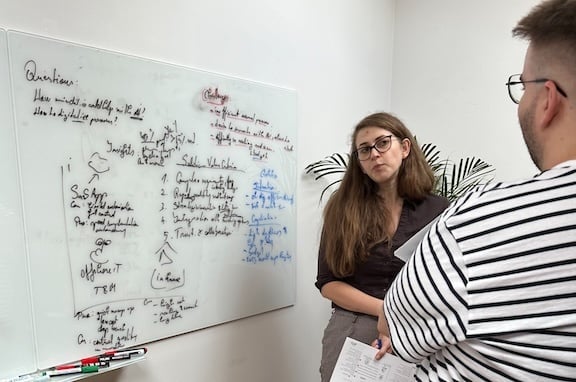
For Siemens, I developed a whiteboard story around COMOS, its industrial engineering and operations platform.
The challenge was helping sellers make a complex business problem understandable, one step at a time, while inviting the buyer into the conversation.
The whiteboard wasn't a presentation. It was a framework for a conversation.
That's an important distinction.
We don't want sellers memorising a drawing and reproducing it, no matter who's sitting opposite them.
We want them to understand the story well enough to adapt it. In this case, the whiteboard is a scaffold to install the story into the salesperson.
3. The Whiteboard Is a Learning Mechanism, Not the Destination
When I started developing whiteboard selling programmes, the goal was to move sellers away from dependency on PowerPoint.
But today, my ambition goes further.
SLIDES → WHITEBOARD → CONVERSATION
First, sellers learn the story.
Then they practise explaining and drawing it.
Eventually, they internalise the story well enough to have the conversation naturally, without relying on slides or a whiteboard.
We're developing two capabilities.
Conversational competence: Understanding the story, explaining it clearly and asking relevant questions.
Situational fluency: Recognising what's happening in the buyer's world and adapting the conversation accordingly.
A seller might meet a buyer who's only beginning to recognise a problem.
Another might be comparing alternatives.
A third might be struggling to build internal agreement.
The same memorised pitch won't serve all three.
The goal is to help them know what to say, when, and why.
And that takes practice.
4. A Workshop Isn't Enough Either
There's another challenge with relying on the SKO to launch a new sales story.
People forget.
Even when the story is compelling and the workshop engaging, sellers return to demanding customers, crowded calendars and competing priorities.
What happens three weeks later?
How does someone revisit the story? What about the seller who missed the event or joins six months afterwards?
This is why I increasingly see whiteboard storytelling as part of a wider learning system.
An animated version can introduce the narrative before the SKO, reinforce it afterwards and support onboarding long after the event.
I saw the potential of this approach back in 2012.
I developed a complex client virtualisation whiteboard for HP. Working with TruScribe, we turned it into an animated video for onboarding and sales enablement.
The important lesson: a story developed for a sales conversation should become a reusable learning asset.
Today, that opens up broader possibilities.
A buyer-grounded story can support live workshops, animated learning, product launches, partner enablement and ongoing onboarding.
But there's a limit.
Watching a video doesn't make someone conversationally fluent any more than watching a cooking programme makes someone a chef.
Sellers still need to practise, receive feedback and learn to adapt.
Animation supports understanding and recall. Workshops develop conversational competence. Coaching builds adoption.
These aren't competing approaches. They're complementary parts of the same learning process.
5. Make the SKO the Beginning, Not the End
Too many sales enablement programmes measure success at the point of delivery.
How many sellers attended?
Did they enjoy the workshop?
Did they complete the training?
Those measures tell us very little about whether anything changed.
The real test comes afterwards.
Are sellers opening conversations differently?
Are they exploring customer problems more effectively?
Are they adapting their stories to different buying situations?
Are managers reinforcing the new approach?
I think about the desired outcomes in three stages:
OPEN BETTER
Start conversations around the problems and circumstances buyers recognise, rather than leading with product capabilities.
EXPLORE BETTER
Ask questions, uncover the buyer's situation and use the story to develop shared understanding.
ADVANCE BETTER
Help buyers understand their options, build confidence and move towards a decision.
That's what sales activation should achieve.
And it requires reinforcement beyond the event itself.
Managers need to observe conversations, provide feedback and encourage sellers to use the story in the field.
A story that isn't used has no commercial value.
6. A 60-Day Sprint to Make Your 2027 SKO Count
You don't need a year-long transformation programme to get started.
But you do need to work backwards from what sellers should be doing differently after the event.
Here's how I'd approach the first 60 days.
Days 1–15: Discover the Customer Truth
Interview 6-10 recent customer champions.
Understand their buying triggers, alternatives, anxieties and decision criteria.
Compare those findings with the company's existing positioning and sales messages.
Identify the gaps.
Output: A clear understanding of why customers buy and the story sellers need to tell.
Days 16–30: Build the Story
Develop the buyer-grounded story.
Create the conversational whiteboard and supporting customer-hero-stories.
Plan how the story will be introduced, practised and reinforced.
Where appropriate, begin developing an animated version for repeatable learning.
Output: A story designed for real buyer conversations, with a practical learning plan.
Days 31–40: Activate at the SKO
Demonstrate the story.
Help sellers understand its structure and practise using it.
Use role-playing and realistic buyer situations to move beyond memorisation.
Introduce visual learning assets where available.
Output: Sellers who understand the story and have begun developing the confidence to use it.
Days 41–60: Reinforce and Embed
Make the story easy to revisit through animation and other learning materials.
Equip managers to coach it.
Observe how sellers use it in real conversations.
Certify competence within 30 days of the SKO.
Gather feedback and refine what isn't working.
Output: Evidence of adoption, practical improvements and a foundation for continued reinforcement.
A full animation may need a longer production window, so its timing should be planned around the programme rather than forced into the sprint.
The important point is that learning and reinforcement continue after everyone goes home.
7. The Real Return on Your Sales Kickoff
A successful SKO isn't measured by the energy in the room.
It's measured by what happens when sellers return to their daily routine.
Do they understand why customers buy?
Can they explain the value of what they're selling in language buyers recognise?
Can they adapt their conversations to different situations?
And are they doing it?
That's where the return comes from.
Customer interviews help establish the right story.
Whiteboards make it understandable and conversational.
Animation makes it accessible and repeatable.
Workshops, practice and coaching help sellers internalise and use it.
Your 2027 Sales Kickoff shouldn't be where you present the sales story.
It should be where your sales team starts learning to own it.
Book a 20-minute call to discuss your product/solution/platform launch.